

Most companies we talk to believe their privacy standards are adequate. They have a privacy policy, a consent banner, role-based access, and an annual assessment. For the internet of five years ago, that was a reasonable baseline. It isn’t anymore.
Three things changed at once.
The rules multiplied. The U.S. still has no federal privacy law. Instead, 20 states have comprehensive consumer privacy laws in effect as of August 2026, with more taking effect in 2027. Thresholds are falling, too. In mid-2026, Connecticut lowered its applicability threshold from 100,000 consumers to 35,000. Companies that assumed they were too small to be covered may want to take another look. And the rules now reach AI directly. California’s SB 1000, signed September 30 as an urgency measure that took effect the same day, removed the one-million-user threshold from the state’s AI Transparency Act. Its disclosure duties now apply to any provider of a generative AI system publicly available in California, whatever its size.
The penalties got real. Texas finalized a $1.375 billion settlement with Google in October 2025 over its collection of Texans’ location, private-browsing, and biometric data. In California, General Motors agreed to a $12.75 million settlement for selling drivers’ location and driving data to data brokers. It was the state’s first data minimization enforcement action, and Attorney General Rob Bonta was clear about the principle: companies “can’t just hold on to data and use it later for another purpose.” Regulators are no longer asking only whether you protected data. They are asking whether you should have been using it at all.
The architecture changed underneath us. AI agents now read inboxes, query databases, call APIs, and act on behalf of employees and customers. Most of them do this with permissions borrowed from a human, under governance written for a human.
That last shift is the one most privacy programs haven’t absorbed. Role-based access assumes a person with a job title, working at human speed, inside one system. An agent works across many systems at machine speed, and any piece of text it reads can redirect it.
This year we’ve seen agents leak customer records through poisoned web forms and post users’ private content where it didn’t belong. None of these agents were malicious. They were doing what they were built to do, without the boundaries they needed.
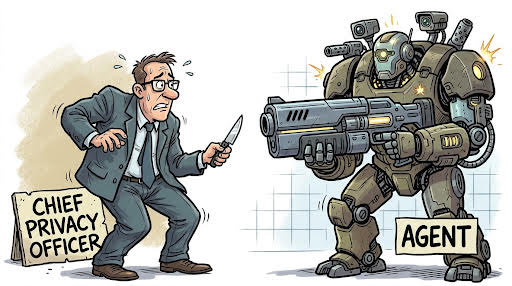
An agent doesn’t have to be malicious to leak data. It only has to be helpful.
The answer isn’t to stop deploying agents. It’s to stop governing them with coarse controls. “This agent can access the CRM” is not a privacy control.
Some companies are reaching for the coarsest control of all: a ban. In November, United Airlines said it will block third-party personal AI agents from booking or changing tickets on its platforms, citing the risk to customers’ data. Amazon has blocked outside shopping agents, including Meta’s Muse, from its store, though CEO Andy Jassy has said he hopes that will change. A ban is understandable when you can’t see what an agent will do with the data it touches. But it won’t hold as more customers send agents to act for them. What will hold is governance precise enough to say yes to the right agent, for the right task, with the right data.
Here is what fine-grained governance actually looks like:
- Source. Which systems, and which tables or folders within them, can this agent touch? Not “the CRM.” The specific records its task requires.
- Content type. Can the agent see personal information, sensitive data (health, financial, children’s, location), or bystander data about people who never interacted with you? Each of these should be governed separately, not bundled together. Where the task doesn’t need identifiable data, filter, redact, or de-identify it before the agent ever sees it.
- Read vs. write. Reading a record is a different risk from changing, sending, or deleting it. Most agents need far less write access than they’re given.
- Time. Access should expire when the task ends, not when someone remembers to revoke it.
- Purpose. Data collected for customer support shouldn’t quietly feed marketing just because an agent found it useful. Purpose limitation is now an enforcement priority, not a footnote.
- Use. What may the agent do with what it sees? Summarize it? Store it? Use it to train or fine-tune a model?
- Sharing. Where can its outputs go: to another agent, a third-party tool, a customer, the open web? Every handoff is a disclosure. When the destination is a model provider or other vendor, your contract should carry the same limits: what they may retain, whether they may train on it, and where they may pass it next.
If your current program can’t answer these seven questions for every agent in production, your standards aren’t sufficient. That isn’t a judgment. It’s where nearly everyone is today. The companies that close this gap first will be the ones deploying agents with confidence while everyone else is writing incident reports.
So here’s a question worth putting to your team this week. Pick one agent you have in production. Can you say exactly what data it can read, what it can change, how long it keeps access, why it has that access, and where its outputs go?
If the answer takes more than a minute, let’s talk.


